Virtuoso Projects & Engineers Pvt Ltd

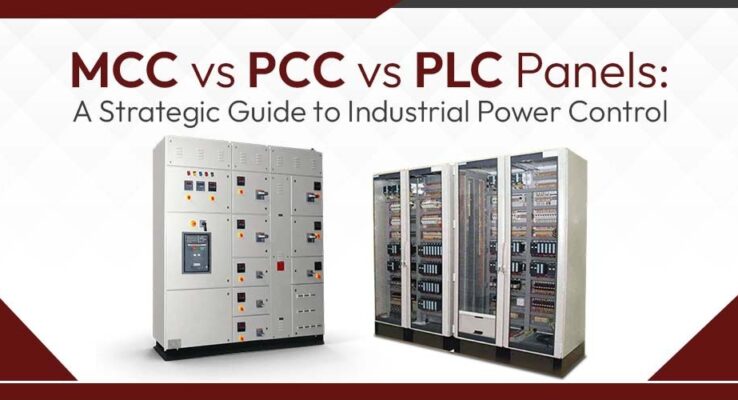
MCC vs PCC vs PLC Panels: A Strategic Guide to Industrial Power Control
In the high-stakes environment of industrial operations, where uptime and safety are non-negotiable, the electrical infrastructure is the fundamental underpinning of success. The control panels that manage your power and processes are not merely metal enclosures; they are mission-critical components that dictate your facility’s efficiency, longevity, and capacity for growth.
As a seasoned executive operating with a value-driven outlook, you must approach the selection of your Motor Control Center (MCC), Power Control Center (PCC), and Programmable Logic Controller (PLC) Panels not as a technical procurement exercise, but as a long-term strategic investment in your operational excellence.
These three systems form a crucial, integrated hierarchy, each fulfilling a distinct mandate. Understanding this core differentiation is the key to minimizing risk and maximizing operational throughput.
1. The Foundation: PCC (Power Control Center)
The Power Control Center (PCC) panel serves as the strategic cornerstone and primary distribution nexus of your entire electrical ecosystem. It is the chief gatekeeper, typically receiving the incoming high-capacity, high-tension (HT) power directly from your main transformer or generator source.
What is its Mandate?
The PCC’s primary role is high-capacity power distribution and plant-wide system protection. It houses the largest components Air Circuit Breakers (ACBs), heavy busbars, and protection relays designed to handle massive fault levels and ensure foundational stability. Think of the PCC as the plant’s Fiscal Controller: it manages the main budget of electricity, allocating large blocks of power safely to various departments and sub-systems, including all downstream MCCs, lighting, and HVAC systems.
The Executive View: A robust PCC is your first line of defense against catastrophic failure. It is where you establish fault isolation and system integrity. Compromising on the quality or capacity of your PCC is a short-sighted decision that exposes your entire operation to unacceptable risk.
2. The Workhorse: MCC (Motor Control Center)
The Motor Control Center (MCC) panel is the centralized engine room the operational workhorse tasked with the control and protection of all your facility’s motors. It draws its power feed from the upstream PCC.
What is its Mandate?
MCCs are built to manage Low-Tension (LT) motor power and control specific electrical loads such as pumps, fans, compressors, and conveyor systems that are the literal drivers of your manufacturing processes. An MCC centralizes vital components like motor starters, Variable Frequency Drives (VFDs), contactors, and overload relays into a single structure.
The Executive View: The MCC directly impacts operational throughput. Its modular architecture, often featuring draw-out units, is a time-tested principle for reliability. This design allows for rapid component replacement and maintenance without shutting down the entire bus section, significantly reducing system downtime. The choice here reflects a commitment to minimizing interruption and ensuring the consistent, efficient execution of all core processes.
3. The Intelligence Layer: PLC Panel (Programmable Logic Controller Panel)
The PLC Panel is the facility’s Strategic Command Center. Unlike the PCC and MCC, which are primarily concerned with power movement and motor health, the PLC Panel is concerned with process orchestration and execution of the control philosophy.
What is its Mandate?
This panel houses the Programmable Logic Controller (PLC) the dedicated, purpose-built industrial controller along with Human-Machine Interfaces (HMIs) and I/O modules. Its function is to read input signals from the field (sensors, limit switches) and execute a pre-determined, sequential series of operations to control the output devices (valves, solenoids, or instructing the MCC to start a motor).
The Executive View: A well-designed PLC system is your pathway to competitive advantage. It embodies a forward-thinking perspective by enabling precise process control, sophisticated safety interlocks, and the flexibility to adapt production lines through simple reprogramming rather than costly hardware changes. When you invest in a scalable PLC architecture, you are investing in an innovative solution that future-proofs your processes and drives process optimization.

A Strategic Synthesis: Integration and Impact
The difference between these panels is one of function and hierarchy:
Panel Type | Primary Function | Electrical Role | Strategic Impact |
PCC | Power Distribution | Main Incomer (HT/High Capacity) | Foundational Stability & Risk Mitigation |
MCC | Motor Control | Feeder to Motors (LT) | Operational Throughput & Reliability |
PLC | Process Automation | Logic Execution & Control Signal | Competitive Advantage & Optimization |
In a fully integrated architecture, the PCC receives the main power. It distributes that power to the MCCs. The PLC Panel, sitting above the MCC, sends the high-level control logic the instruction to the contactors and starters within the MCC to initiate motor action, monitor its status, and manage protective measures. This mission-critical synergy ensures that power management (PCC), equipment protection (MCC), and complex automated sequencing (PLC) function in perfect harmony.
The decision is not “which one to choose,” but rather, “how do we design the holistic system view?” This is where the practicality of working with an experienced, value-driven partner is paramount. They can help you structure your infrastructure to meet current demand while providing the headroom necessary for future expansion and evolving production mandates.
To secure your investment for the long term, we encourage a robust consultation process that carefully maps your control philosophy to the right panel architecture.