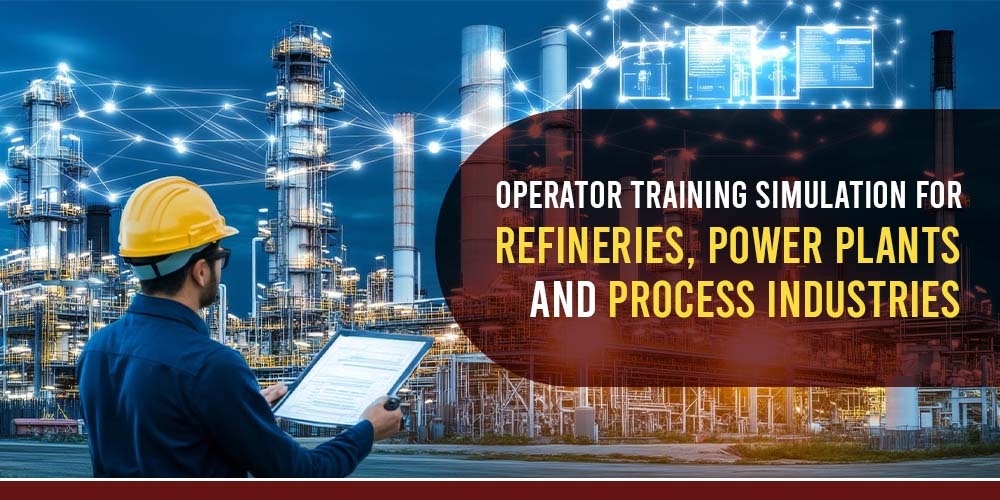
Operator Training Simulation for Refineries, Power Plants, and Process Industries
Plant operations leave very little room for error. One wrong valve action or delayed response can lead to safety incidents, production loss, or equipment damage. This is where operator training simulation plays a direct and practical role.
Instead of learning only on live systems or classroom diagrams, operators train on realistic process models that behave like the real plant. They make decisions, see outcomes, and learn from mistakes without real-world risk. For industries like oil and gas, power generation, chemicals, and utilities, this approach has become a practical necessity rather than a nice-to-have.
What Is Operator Training Simulation?
Operator training simulation (often called OTS) is a digital replica of a plant’s process and control system. It allows operators to practice normal operations, start-ups, shutdowns, and abnormal situations in a controlled environment.
The simulator responds exactly like the real system. If an operator changes a setpoint, opens a valve, or ignores an alarm, the process reacts the same way it would in the actual plant.
Why Refineries and Power Plants Rely on Simulation Training
Process industries operate under high pressure, high temperature, and strict safety rules. Live training during abnormal events is risky and often impossible.
Operator training simulation helps by:
- Allowing practice of rare but critical scenarios
- Reducing dependency on on-the-job trial and error
- Improving coordination between field and control room staff
- Supporting consistent training across shifts and sites
For regions with growing industrial capacity, training new operators quickly and safely is a major challenge. Simulation-based training solves this without interrupting production.
Key Use Cases Across Process Industries
Refineries and Petrochemical Plants
- Crude unit start-up and shutdown
- Compressor trips and furnace failures
- Alarm management and response timing
Power Plants
- Boiler control and turbine operation
- Load changes and grid disturbances
- Emergency shutdown procedures
Chemical and Process Plants
- Batch process handling
- Reaction control and safety interlocks
- Equipment failure scenarios
How Operator Training Simulation Improves Safety
Safety procedures look simple on paper. In real operations, stress and time pressure change everything.
With operator training simulation, teams can repeatedly practice:
- Identifying early warning signs
- Responding to alarms in the right order
- Communicating clearly during incidents
- Recovering the process safely
Over time, correct responses become habit. This directly lowers the chance of human error during real events.
Step-by-Step: How a Typical OTS Program Works
Step 1: Define the Scope and Delivery Milestones
The project begins by defining what the simulator must cover. This includes:
- Units and systems to be simulated
- Operating modes such as start-up, shutdown, and normal operation
- Abnormal and emergency scenarios, Clear milestones are set so development, testing, and training stay on schedule.
Step 2: Model Development
Engineers build dynamic process models using actual plant data, operating limits, and design documents. These models replicate real process behavior such as pressure changes, heat transfer, and flow dynamics, not just steady-state conditions.
Step 3: Design Training Scenarios
Normal, abnormal, and emergency scenarios are defined.
Step 4: Train and Assess Operators
Operators run scenarios while trainers evaluate decisions and response time.
Step 5: Continuous Improvement
Scenarios are updated as the plant or procedures change.
Benefits for Plant Owners and Managers
- Fewer operational incidents
- Faster onboarding of new operators
- Better compliance with safety standards
- Lower maintenance and downtime costs
- More confident and capable teams
Companies like Virtuoso Projects & Engineers Pvt Ltd focus on building realistic simulation environments that match actual operating conditions, making training more effective and relevant.
Common Mistakes to Avoid When Adopting OTS
- Using generic models instead of plant-specific simulations
- Treating simulation as a one-time training activity
- Not updating scenarios after process changes
- Skipping performance assessment and feedback
A simulator is only useful when it mirrors reality closely and is used regularly.
FAQs
What is operator training simulation used for?
It is used to train plant operators on realistic process behavior without risking actual equipment or safety.
Is operator training simulation suitable for experienced operators?
Yes. It helps experienced staff practice rare emergency and abnormal situations they may never see in daily operations.
Can OTS reduce plant unplanned shutdowns?
Yes. Better-trained operators respond faster and make fewer mistakes, which reduces unplanned shutdowns.
Does operator training simulation replace on-the-job training?
No. It complements on-the-job training by preparing operators before they handle live systems.
Which industries benefit most from operator training simulation?
Oil and gas, power generation, chemicals, petrochemicals, and other high-risk process industries.
Conclusion
Operator training simulation gives process industries a safer, smarter way to prepare their teams. By practicing real scenarios in a risk-free environment, operators gain confidence, accuracy, and speed.
For refineries, power plants, and complex process facilities, this kind of training directly supports safer operations and better long-term performance. If your goal is fewer incidents and stronger operator skills, simulation-based training is a practical step forward.